
Why Choose a Havanese?
The Havanese is a charming, affectionate, and intelligent breed that makes a perfect pet for a wide range of living situations. Whether you have a busy lifestyle or prefer a more laid-back routine, the Havanese can adapt and thrive. Let’s explore the many benefits of owning a Havanese:
 Smart & Easy to Train
- Intelligent & Eager to Please: This makes training easy and enjoyable for both you and your dog.
- Quick Learners: They excel in obedience, agility, and even therapy work.
- Great for First-Time Dog Owners: Their ability to understand commands and follow routines makes them manageable and fun to train.
Affectionate and Friendly Temperament
- Loyal & Loving: Havanese dogs are known for their friendly, affectionate nature.
- Great with Children: Their gentle temperament makes them wonderful family pets.
- Social & Playful: They thrive on human companionship and enjoy cuddling or playing games.
- Adaptable in Social Situations: Their friendly disposition makes them great in various environments.
Health & Longevity
- Long Life Expectancy: The Havanese typically lives 14 to 16 years, giving you many years of love and companionship.
- Healthy & Resilient: With proper care, routine vet check-ups and a balanced lifestyle, Havanese are generally healthy and less prone to hereditary issues common in other small breeds.
Compact Size & Adaptability
- Perfect for smaller spaces: With a height of 8.25 to 11.5 inches, they are the ideal size for smaller spaces.
- Energetic Yet Sturdy: Despite their small size Havanese are sturdy and energetic, they enjoy both indoor and outdoor activities, making them adaptable to any lifestyle.
Perfect for Active or Relaxed Lifestyles
- Versatile & Adaptable: Whether you enjoy hiking, playing fetch, or simply relaxing at home, the Havanese will happily join in.
- Active Dogs: They enjoy outdoor play and exercise, but they’re also content to curl up beside you for a quiet evening at home.
- Great for Families & Individuals: From energetic families to those seeking a calmer companion, the Havanese fits every lifestyle.
- Skilled in Dog Sports: Naturally athletic and agile, Havanese excel in dog sports such as agility, rally, and obedience, offering fun challenges for active owners.
Grooming Made Simple
- Hypoallergenic Coat: Ideal for families with allergies as they shed less and produce less dander.
- Regular Grooming: Their silky coat requires regular brushing, but it can be clipped for easier maintenance.
- Low Shedding: They make an excellent choice for allergy sufferers who still want a furry friend!
A Lifelong Companion
Owning a Havanese means bringing a loving, loyal, and intelligent dog into your life. Their friendly personality, easy trainability, hypoallergenic coat, and adaptability make them an excellent choice for families, individuals, and anyone seeking a wonderful companion. If you're ready for years of joy, companionship, and affection, the Havanese is the perfect fit!
Colours
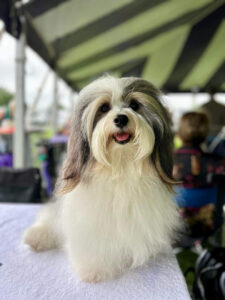
Havanese come in a wide variety of colours and patterns including cream, gold, white, black, silver, chocolate, sable, and combinations of these. Markings and shading may change as the dog matures. Some Havanese retain their puppy colours, while others may lighten or darken over time.
Amusing Quirks
Havanese are known for their entertaining antics and clever charm. They often tilt their heads when listening, giving them a curious and endearing look. Some enjoy climbing onto the back of a couch or curling up on a shoulder, always seeking a better view and the comfort of their people.
These dogs invent their own games, dash wildly around the house in joyful bursts of energy and engage in imaginative play with toys. Many have a fondness for paper, happily shredding it into tiny bits, and some are masters at pretending innocence when caught in the act. With their expressive eyes, lively movements, and unmistakable personality, Havanese bring constant amusement to those who appreciate their one-of-a-kind spirit.
Origin of the Havanese
Originating in the Western Mediterranean region, Havanese are descended from old world Bichon types. Early sea merchants brought these small dogs to Cuba where the breed was further developed and refined; for centuries prized by upper social classes as children’s playmates and loving companions. Though numbers were severely decimated by the Cuban revolution of the late 1950s, the breed has regrown from surviving descendants. No longer a token of high society, the Havanese today is a companion dog to be enjoyed by all.
History of Havanese
The Havanese ("Habaneros" in Spanish) is also known as the Havana Silk Dog. These little "charmers" are a part of the Bichon Family and are descended from the same bloodlines that produced the Water Spaniel, Poodle, and Portugues Water dog.
HISTORY:
The Havanese breed descends from old-world Bichon types of small companion dogs such as antique versions of the Maltese and the Caniche. They are neither Terriers nor Spaniels. This group of small longhaired dogs is very old and originated in the Mediterranean in pre-Christian times. From the original antique “small dog,” numerous varieties evolved. As the centuries passed, interesting variations developed into separate and distinct breeds, each with a slightly different temperament and appearance. Variations, in large part, arose from the preferences of their human caretakers of the time, climatic influence, as well as possible input from other breeds.
The Havanese breed is part of the Bichon family, which includes the Bichon Frisé, Coton de Tulear, Bolognese, Maltese, Bolonka, and perhaps the Lowchen. It is believed that during the days of the Spanish Empire, they were brought to Cuba by sea captains to be sold to wealthy Cuban families, as well as given as gifts to win the favour of wealthy señoras. The breed is thought to have developed without outside influence and evolved unique adaptations for the hot Cuban climate. It is a remarkably heat-tolerant dog due to its unique coat. The coat is like raw silk floss—profuse, but extremely light and soft—and insulating against the tropical sun. In its native country, the coat was never clipped for this reason, and the hair was never tied into a topknot, as the Cubans believe the hair protects the eyes from the harsh sun. It loves the water and is an accomplished swimmer.
By the mid-eighteenth century, they became very popular in Europe. Queen Victoria is said to have owned two, and Charles Dickens had one called Tim, which was much beloved by his seven children. They were exhibited in the early European dog shows, and type was well established.
In Cuba, meanwhile, the times were changing. The aristocracy of the sugar barons was dying out, and a new class was emerging—the bourgeoisie—and the little dog of Havana, adaptable as always, became an exceptional family dog, playmate of children, and watchdog. It is a position he has held there for the past hundred and fifty years. It is said, though debated, that they were also herders of the family poultry flock.
After the Cuban revolution, the Havanese began to die out except for a handful of them who found their way to the United States, where they have slowly but steadily been rebuilt. All the Havanese in the world today, except for those from the “iron curtain” countries and those remaining in Cuba, stem from those 11 immigrants. Throughout their travels, Havanese type has remained virtually unchanged from that of the dogs in the eighteenth century.